Neck Tension and Jaw Clenching: How Ribcage Position Changes the Whole Loop (and What to Do Next)
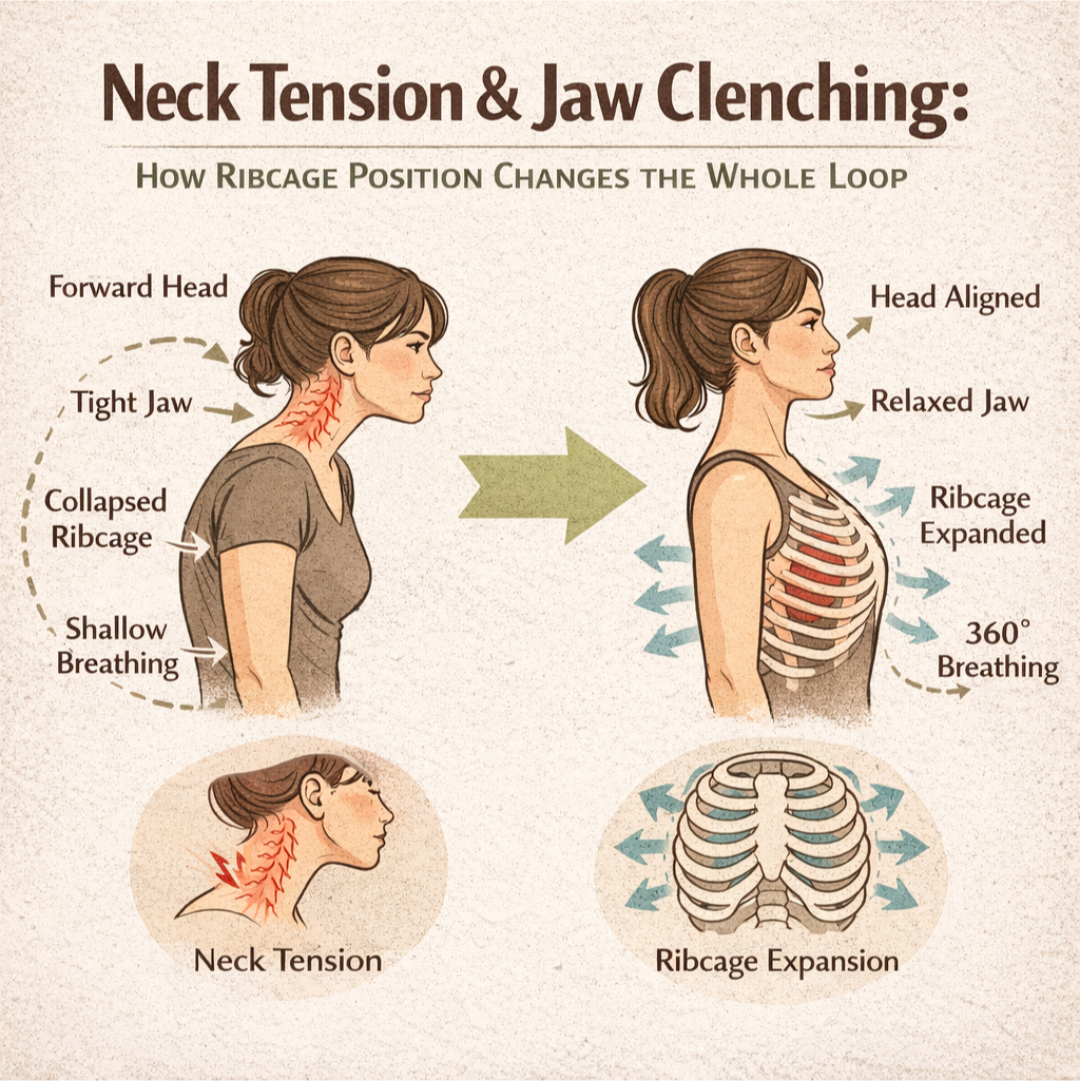
If your neck is always tight and your jaw is always clenched, the answer is usually not that you simply need to relax more.
For many people, neck and jaw tension are part of a larger breathing and stabilization pattern. When the ribcage stays collapsed, the body has less room to expand with each inhale. The neck, upper chest, jaw, and tongue often step in to help create air and stability.
That is why cues like “drop your shoulders” or “stop clenching your jaw” often do not last. You are trying to remove a strategy without giving the body a better one.
In this article, I’ll show you how ribcage position, shallow breathing, tongue and jaw tension, and neck compensation can all feed the same loop, and where to start if you want to change it.
The neck tension + shallow breath loop
Here is the pattern in plain language:
The ribcage stays depressed and does not expand well
Breathing shifts upward because the container is not opening
The neck and shoulders help pull air in
The jaw and tongue increase tone to stabilize
The next breath becomes even smaller and more effortful
Over time, this can become automatic. Your body learns, “This is how we breathe.”
Why ribcage position affects the neck
When the ribcage stays depressed, the upper ribs often lose the buoyancy needed for easy expansion. The torso can start to feel flat, compressed, or held down rather than open and responsive.
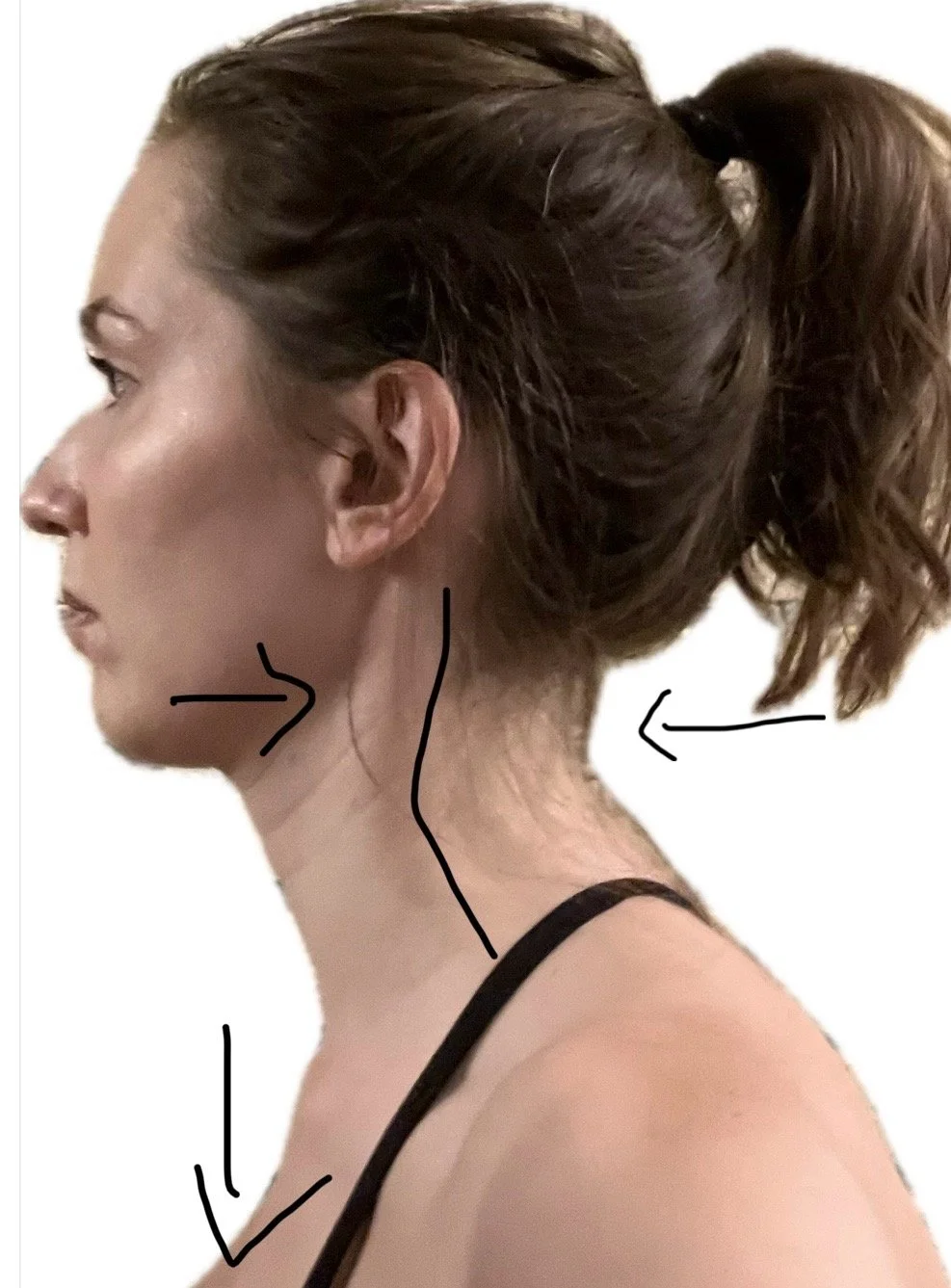
A common compensation looks like this:
Lower cervical flexion
Upper cervical extension to keep the eyes level
This can increase demand through the back of the neck and make the whole system feel stiff and guarded.
In that posture, the neck is often doing too many jobs at once. It is trying to help with breathing, posture, and visual orientation instead of working in coordination with the rest of the trunk.
This is one reason people can feel constant tightness through the front of the neck, the back of the neck, the scalenes, the SCM, and the muscles that elevate the shoulder girdle. The neck may feel overworked, not because it is the true source of the problem, but because it is compensating for a ribcage that is not expanding well.
If this pattern keeps pulling you into your neck and upper chest, my article 360 Breathing: The Key to Optimal Pressure Management and Pain-Free Movement is a good next step.
Tongue and jaw tension are often part of the same strategy
Tongue position influences the palate. The palate influences airflow. Airflow influences rib mechanics.
When the breath stays high and the ribcage does not expand well, the tongue and jaw often increase tone as part of airway and stability management. That is why jaw clenching commonly shows up with:
Shallow or chest-dominant breathing
Tight front neck
Tight scalenes and SCM
A sense of pressure at the throat or sternum
Ribs that feel stuck and do not expand into the sides and back
Jaw tension is often protecting something. It is not always just a bad habit.
A note on tongue ties (and why this is not a diagnosis)
Some people have restricted tongue mobility that can affect swallowing patterns, jaw position, and compensatory tension in the neck. This is not something a blog post can diagnose.
If you suspect tongue mobility restrictions, it may be worth getting assessed by a qualified provider such as a myofunctional therapist, dentist, or ENT.
I mention it because it has been part of my own story. I have had a tongue tie released three times along with myofunctional therapy. Even after that, my tongue still tended to feel tight.
What surprised me most was how much my tongue position improved when I worked on the rest of the system too: ribcage expansion, breathing mechanics, fascial release, and functional movement training.
This is not a claim that posture fixes tongue ties. It is simply a reminder that tongue and jaw tension often have a broader biomechanics and nervous system component too.

Left: Head and neck position after 3 tongue tie releases, 2 palate expanders, and myofunctional therapy. Still compressed and forward. Right: Added focus on breathing mechanics, fascial release, and functional movement training helped expand the ribcage for better neck position, less jaw tension, and more tongue freedom.
If this pattern feels familiar, this is exactly what I built 360 Breathing to address.
The course walks you through how to create ribcage expansion and pressure support progressively — so the jaw, neck, and upper chest can stop compensating because the ribcage is finally doing its job.
One hour of content. $27. Lifetime access.
If you know you want a more individualized approach, this is also the kind of pattern I help people work through in 1:1 coaching.
The key shift: breathing helps reposition the ribcage
When you reposition the ribcage through interior expansion, the neck gets to work in better coordination with the rest of the body.
When the ribs stay collapsed, the breath often shifts upward and the neck becomes a primary helper for breathing. That can keep the jaw, throat, and front of the body feeling tight, like the whole system is bracing to stay upright and get air.
The goal is not to force the neck to relax.
The goal is to build a ribcage that can expand in three dimensions so the neck can stop doing the breathing job and return to being a connector.
Guardrail: “wrap” is not collapse
If your exhale makes you feel shorter, slumped, or more jaw tension, that is collapse, not repositioning. We want space and width, with the ribs softening and wrapping slightly instead of being shoved down.
Try this: a 60-second awareness check
This is gentle. Low effort wins.
1) Stack without packing on tension
Think: tall and easy, not rigid.
Long back of the neck, eyes level
Jaw unclenched
Tongue gently resting on the roof of the mouth, without pressing
Ribs feel wide (not flared, not pinned down)
If you feel your abs or neck gripping to “hold posture,” back off 20%.
2) Inhale wide into the ribs (front, sides, back)
Inhale softly
Feel expansion around the whole ribcage
If shoulders lift, lower the effort
3) Exhale long and soft, keep space
Exhale slowly
Let the ribs soften and wrap slightly while staying wide
Keep the sternum quiet (no lifting, no sinking)
Let the belly support gently without gripping hard
Repeat for five breaths.
What you are noticing:
Does your jaw want to help right away?
Do your shoulders lift when you inhale?
Is it hard to feel your side or back ribs?
Does your neck or throat tense as soon as you try to breathe differently?
Does it feel easier to brace than to sense?
If this feels subtle, confusing, or hard to sense, that does not mean nothing is happening. It often means your body is used to substituting tension for support.
Want the full progression?
If this awareness check gave you even a small shift — or showed you how quickly your neck, jaw, or shoulders want to take over — that is usually a sign the body needs more than a cue to relax.
This is where most people do better with a guided progression.
My 360 Breathing Mini Course teaches you how to:
find expansion through the front, sides, and back of the ribs
reduce neck and shoulder takeover
use pressure-based drills that create space before retraining
build from breathing drills into something your body can actually keep
Why breathing alone is not the whole plan, and why it still matters first
Breathing can help reposition the ribcage and change the pressure dynamics that keep the neck and jaw overworking. But the goal is not just a better breath in one moment.
The goal is a body that can hold and strengthen the new position.
That is where integrated training matters. Once you create more space, the rest of the body has to learn how to organize around it through alignment, connection, and coordinated movement.
Breath opens the door. Training helps you keep it open.
Want help identifying your specific pattern?
If you have been dealing with persistent neck tension, jaw clenching, or a ribcage that still feels stuck no matter what you try, 1:1 coaching may be the right next step.
This is where I can look at your specific structure and compensation patterns, not just the general one, and build a plan around what your body actually needs.
In 1:1 coaching, we focus on:
aligning ribcage and head placement for your structure
restoring trunk support so the neck stops compensating
integrating breathing with strength and gait-based patterns
building coordination the body can actually keep
Final takeaway
Jaw clenching is rarely just a habit.
It is often a stabilizing strategy that shows up when the ribcage is collapsed and the neck is doing too much.
Start by creating more ribcage expansion and giving the body a better breathing option. Then train the rest of the body to hold that option with better alignment, connection, and glide.
Read next
Collapsed Ribcage + Serratus Anterior: The Missing Muscle Most People Never Train
Can’t Get 360° Ribcage Expansion? Your Pelvic Floor Might Be Blocking It
Why You Can't "Just Relax": Nervous System Guarding Explained
Tongue Tone and Lymph Support: Why Your Jaw and Neck Might Stay "Stuck"
Breathing Exercises for Anxiety Relief: Why Most Techniques Miss the Real Problem