Why Stretching Makes Tightness Worse: Understanding Fascial Release & Functional Movement

You have felt it before.
That tight spot in your hamstring. The knot in your shoulder that never fully goes away. The neck tension that makes you wince when you turn your head.
So you stretch.
You hold the position for 30 seconds, maybe a minute. You do it every day. And yet the tightness keeps coming back. Sometimes it even feels worse.
What if the problem is not that the tissue is too short?
What if pulling on “tight” tissue is sometimes making the real problem worse?
The Knot in the Band
Imagine a stretchy resistance band with a knot tied in the middle.
Now pull the two ends apart like you are stretching it.
What happens?
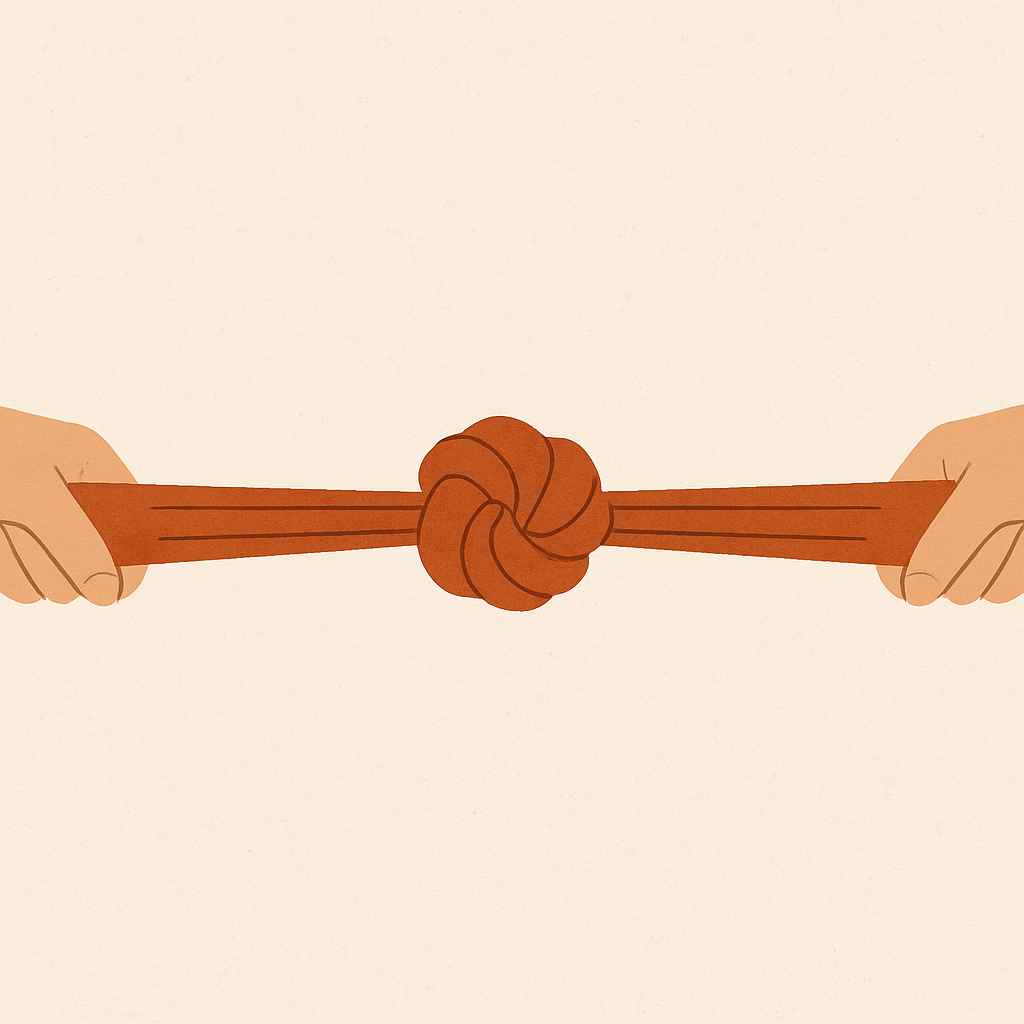
The knot gets tighter. More compressed. More tangled.
And the sections around it, the parts that were already loose, get stretched out even more. They become thinner, less stable, and more prone to strain.
That is often what happens when you repeatedly stretch tissue that is dealing with restriction, adhesion, guarding, or compensation.
The issue is not always that the tissue is too short. Sometimes it is that the system is too compressed, too stuck, or too overloaded.
What We Get Wrong About "Tight" Muscles
Most people think tightness means one thing: the muscle needs to be made longer.
But your body is not a collection of isolated muscles floating in space.
Everything is wrapped in fascia, a continuous web of connective tissue that links one area to the next and helps distribute tension, force, and movement across the whole body.
So when something feels “tight,” you may not be feeling a muscle that is too short.
You may be feeling:
guarding, where your nervous system is holding tension to protect an unstable area
compensation, where one area is doing too much because another area is not doing its job
adhesion, where fascial layers that should glide are no longer gliding well
compression, where tissue feels jammed, pinned down, or crowded
overstretch, where tissue is already long but still gripping for support
That “tight” hamstring may actually be overworked and under-supported. That stiff upper trap may not need more length. It may need less compensation.
If you want the broader picture of how fascia shapes pain, posture, and movement, start here: Fascia: The Hidden Web That Shapes Your Movement, Posture & Health.
Why Traditional Stretching Often Fails
Traditional stretching is built on a simple idea:
If it feels tight, make it longer.
But that logic often misses the real issue.
1. It ignores the fascial system
Fascia is continuous. When you pull on one area, you influence tension elsewhere.
You cannot isolate a muscle any more than you can pull one strand of a spider web without affecting the rest of the web.
2. It addresses length, not function
A muscle can be long enough and still feel tight because it is overworking, poorly coordinated, or compensating.
Length without support is not freedom. Often, it is instability.
3. It removes a strategy without replacing it
If your body is using tension to protect a joint, create stability, or manage a compensation pattern, stretching may temporarily reduce the tension without solving why the body needed it.
That usually means the tightness comes back.
4. It can make loose areas looser
If tissue is already under-supported, repeatedly stretching it can make the whole system feel less organized.
That often creates more guarding, not less.
What Fascial Release Actually Does
Fascial release approaches the problem differently.
Instead of pulling the knot tighter, it tries to create enough space, pressure change, and tissue glide for the system to reorganize.
Real fascial work often helps by:
Addressing compression, not only length
The goal is not just to “lengthen” tissue. It is to reduce the jammed, crowded feeling inside the system.
Restoring glide between layers
Fascia should glide:
muscle over muscle
skin over tissue
organs against surrounding structures
one line of tension against another
When that glide is lost, movement starts to feel restricted, sticky, or effortful.
Working with the whole system
Pain and restriction do not always live in the same place.
A tight hip may be related to:
ribcage restriction
foot mechanics
a pelvic shift
a neck pattern
an opposite-side compensation
Including movement, not just pressure
Sometimes release work is simple. It may be lying on a ball, using sustained pressure, or giving compressed tissue enough time and input to start softening.
That can be helpful. But release is not the whole answer.
If the body does not then learn how to find and hold better positions, the same tension patterns often come back.
That is why release work is usually most useful when it is followed by better breathing, improved coordination, and movement that helps the body keep the new space it just found.
Fascial restriction does not only affect movement. It can also change how fluid moves through the body, which is one reason tension often shows up alongside puffiness, congestion, or slow recovery. If you want that deeper layer, read The Fascia–Lymph Connection: Why Tight Tissue Blocks Drainage, Detox & Natural Glow
One of the best places to start: the ribcage
One of the most powerful places to begin fascial work is the ribcage.
When the ribcage is compressed, it affects:
breathing
posture
trunk support
neck tension
shoulder mechanics
pressure distribution through the whole body
That is one reason so many patterns feel like they are “everywhere.”
One of the most powerful places to start creating space is the ribcage.
When the ribcage is compressed, everything else compensates — neck, shoulders, hips, low back. The 360° Breathing Course uses pressure-based exercises to create real internal expansion through the ribcage so your body has a better foundation to work from. Not breathing harder. Creating space first.
One hour of content. $27. Lifetime access. Posture-specific so you're working on what your body actually needs.
Not sure whether you are dealing with stretching needs or fascial restriction?
That confusion is common.
Most people have been told that if something feels tight, they need more flexibility.
But chronic tightness that keeps returning is often a sign that the issue is more about restriction, compensation, or poor load distribution than true shortness.
Training That Respects Fascial Movement
Release work helps create space. Training helps your body use that space well.
This is where a lot of people get stuck.
They release tension, but then go right back into the same movement patterns that created the problem.
Movement that respects the fascial system tends to include:
multi-planar motion because fascia transmits force in spirals, diagonals, and chains, not just straight lines
range with control because usable, organized motion matters more than maximum flexibility
integration over isolation because the body works better as coordinated systems, not disconnected parts
elastic recoil because fascia is designed to store and release energy like a spring
balanced tension because you do not want collapse in one area and overwork in another
coordination because mobility without control often just becomes instability
If you want to see how the feet influence the rest of the chain, read The Best Foot Tools for Fascia, Alignment & Pain-Free Strength (And How to Use Them at Home)
My turning point
For years, I thought I was training my whole body well.
On paper, I was getting stronger. But I was also getting more compressed, more restricted, and more uncomfortable.
I had strength, but it was not translating. I was not moving better through daily life. Tasks did not feel easier. The chronic pain I had been dealing with was not improving. In many ways, it was getting worse.
What I was missing was not effort. It was a better understanding of how my body was organizing tension.
I needed to understand:
how fascia shapes force transfer and restriction
how compression can masquerade as “tightness,” and how some tight areas can actually be under-supported or hypermobile elsewhere
how elastic recoil and coordinated load matter more than isolated strength
how creating space and glide changes what strength can actually do
What changed things was not just getting stronger. It was learning how to create space, reduce restriction, and train movement in a way that matched how the body is actually designed to work.
If you have ever noticed your posture shift with stress, bracing, or emotion, read How Emotions Affect Your Spine and Physical Alignment.
The Path Forward
This does not mean stretching is always bad.
It means you should question what the tightness is actually telling you.
Before you stretch, ask:
Is this area truly short, or is it guarding?
Am I feeling restriction, or compensation?
What is this area doing for me right now?
What is missing that is forcing it to work so hard?
Am I building support and coordination, or just pulling on tissue?
Your body is not a collection of parts that need to be lengthened in isolation.
It is an integrated system.
And when you work with that system, by restoring glide, creating space, improving pressure management, and building coordinated strength, tension often starts to resolve in a much more lasting way.
The knot does not need to be pulled harder. It needs to be intelligently untangled.
If stretching has not worked for you, it may be because the tissue is acting more like a stabilizer than a tissue that truly needs more length. This is especially important in bodies where asymmetry and compensation patterns are shaping how force gets distributed. If that sounds familiar, read Functional vs Structural Scoliosis and Why it Matters for Your Body
Your next step
If stretching has not worked for you, it may be because the tissue is acting more like a stabilizer than a tissue that needs more length.
If you are dealing with:
chronic tightness that always returns
postural patterns that feel stuck
areas that feel restricted rather than simply short
pain patterns that move around
a body that feels like it is always compensating
Want help applying this to your body?
If you are ready for a more individualized approach, I offer 1:1 movement coaching through RootForce.
This is where we look at:
the patterns your body is relying on
where tension is compensating for missing support
how your breathing, posture, and movement are interacting
what kind of retraining will actually make sense for your structure
FAQ
Why do my muscles feel tight even after stretching?
Because tightness often comes from guarding, compensation, fascial restriction, or compression, not just a lack of length.
Is stretching bad for fascia?
Not always. But repeatedly stretching tissue that is already unstable, compensating, or compressed can make the problem worse.
What is fascial release?
Fascial release helps restore space, glide, pressure balance, and tissue organization so movement becomes easier and less defended.
How do I know if fascia is part of the problem?
Recurring tightness, pain that keeps returning, areas that feel both weak and tight, and patterns that do not improve with more stretching are common clues.